



Mountain tours are not only an adventure for body and mind, but also a real challenge for endurance and balance. Anyone who regularly ventures into the mountains knows: good equipment makes the difference – and this includes, above all, high-quality hiking poles. A folding trekking pole has become indispensable in modern outdoor equipment. Compact, lightweight and functional, it supports hikers on demanding terrain and makes every tour safer, more efficient and more enjoyable.
Why a trekking pole is essential on mountain tours
Many underestimate the role of a trekking pole on a mountain tour. However, this small helper not only relieves strain on your joints but also significantly improves stability on uneven or slippery terrain. Especially during long ascents and descents, it protects your knees and provides more even weight distribution. Studies show that the load on knee and hip joints during downhill hiking can be reduced by up to 25%.
A folding trekking pole also provides additional support when the ground is rocky, muddy or snow-covered – a crucial safety advantage. When crossing streams, hiking on scree or tackling steep ascents, poles help you maintain balance and avoid falls. At the same time, they train your arm and shoulder muscles – a real bonus for physical fitness. For more information on proper use, you'll find valuable tips in our guide on how to use hiking poles correctly.
The advantages of a folding trekking pole
A folding trekking pole is not only functional but also incredibly practical. Compared to telescopic models, it collapses in seconds and stores compactly in your backpack. This makes it ideal for travel, light-packing hikes or multi-day trekking tours where weight and pack size are crucial.
- Compact design: When collapsed, a modern folding trekking pole often measures less than 40 cm. So it fits easily into your backpack or can be attached to the outside.
- Lightweight: Models made from high-quality materials like carbon or aluminium are particularly light without compromising on stability.
- Easy to use: Folding and unfolding works with just a few hand movements – perfect when you need support spontaneously during an ascent or descent.
- Versatile applications: Whether for mountain hiking, trail running or snowshoe walking – a folding trekking pole works in any environment.
Flexibility is crucial especially for winter adventures. Read more about this in our article Folding trekking pole – ideal for winter hikes and compact backpacking.
Material and construction: What matters
Not all trekking poles are the same. A high-quality folding trekking pole should be stable, durable and lightweight at the same time. Materials like carbon or 7075 aluminium offer the ideal balance between weight and stability. Carbon is particularly light and vibration-damping, while aluminium convinces with its high robustness. Which material suits you best can be found in our hiking poles test 2026: Carbon vs. Aluminium. If you value maximum lightness, you should also check out our overview of carbon hiking poles.
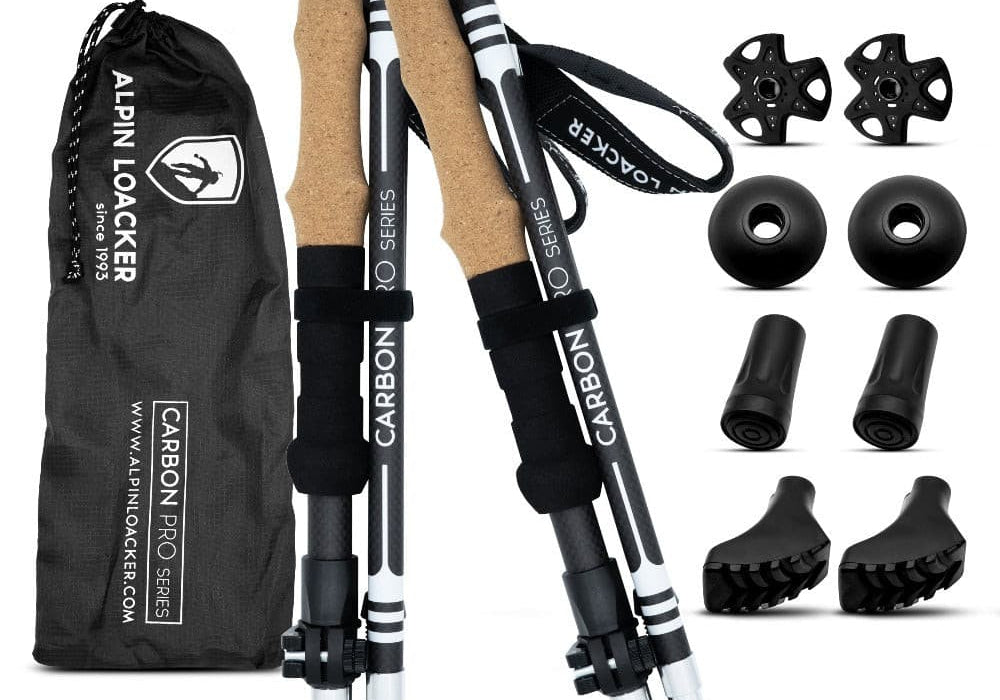
The grips also play an important role: ergonomically shaped grips made of cork or EVA foam provide comfortable grip and prevent blistering – even on long tours. Cork also has the advantage of absorbing moisture and not feeling unpleasant in the heat. The tips of a good trekking pole are usually made from hard metal to provide optimal grip even on rocky terrain. For soft ground or asphalt, suitable rubber buffers can be attached to minimize wear and noise. Our article on hiking poles: which tip for which terrain shows which tip is ideal for which surface.
How to choose the right trekking pole
Choosing the right trekking pole depends on several factors – including your height, terrain and personal preferences. A rule of thumb says: your elbow should be at a 90-degree angle when holding the pole. Many folding models are also height-adjustable, so they can adapt to different conditions – shorter for ascents and longer for descents.
A folding trekking pole is particularly practical for travellers or minimalists who care about low weight and easy handling. If you often plan challenging multi-day tours, you should also look for locking mechanisms that remain secure under load. Alpin Loacker's folding carbon models, for example, combine lightweight design with high stability – ideal for ambitious hikers seeking uncompromising performance.
Frequently asked questions about folding trekking poles
How heavy is a good folding trekking pole?
High-quality carbon models usually weigh between 200 and 250 grams per pole, aluminium variants are around 250 to 300 grams. What matters is the ratio of weight, stability and pack size – a lightweight pole saves noticeable energy on long tours.
Are folding trekking poles stable enough for demanding tours?
Yes. Modern folding trekking poles made from carbon or 7075 aluminium withstand high loads. What's crucial is a reliable folding system with firm locking that remains secure even on steep descents or slippery ground.
How do I care for my folding trekking pole properly?
After each tour, you should unfold the pole, remove dirt and moisture and let it dry completely. This prevents corrosion and jamming. Moving parts can occasionally be maintained with a little silicone spray to keep the mechanism running smoothly long-term.