












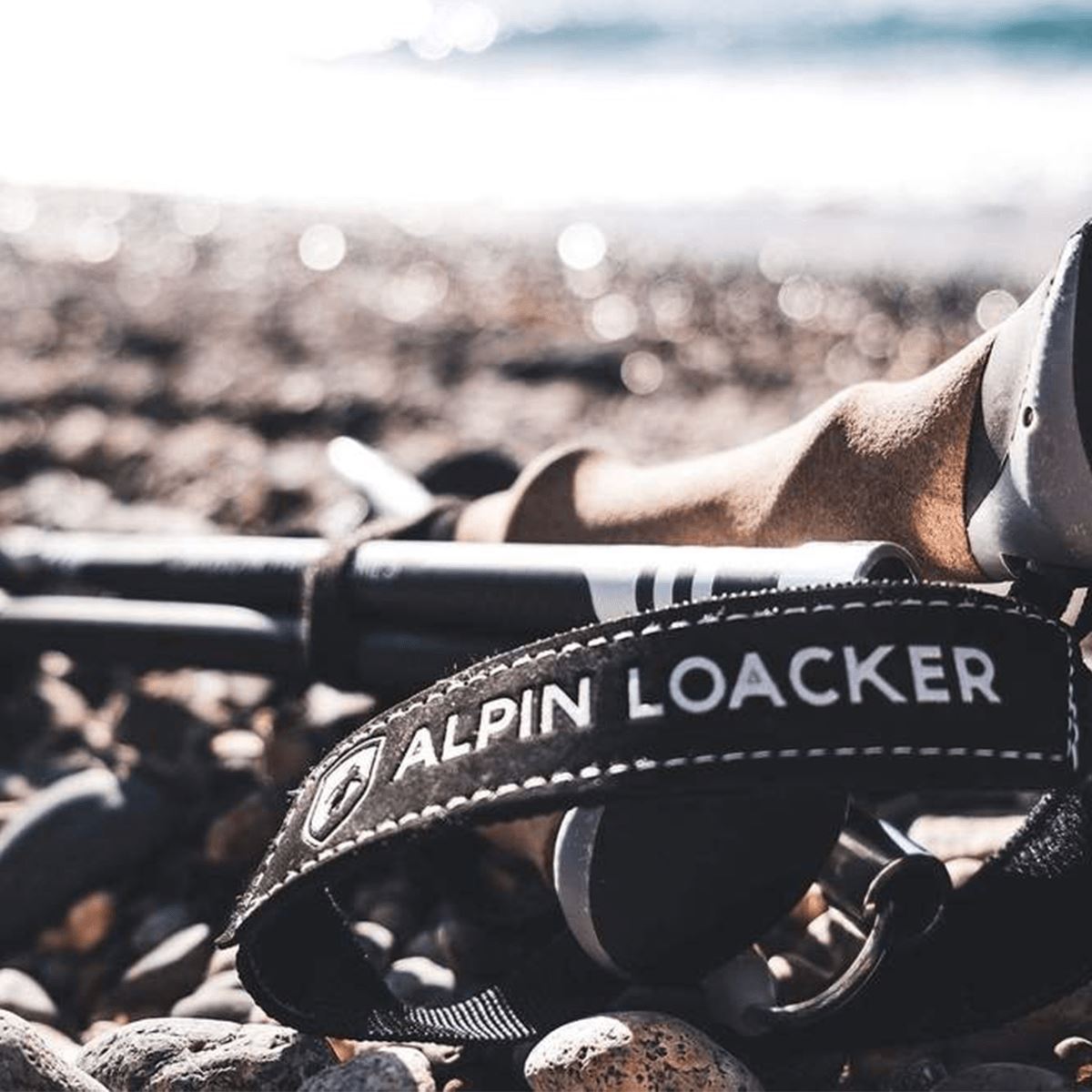
One thing upfront: neither material is better or worse than the other. It depends much more on your personal preferences and intended use. Whether you choose carbon or aluminum hiking poles is entirely up to you.
To make your choice easier, we have compiled the most important features and criteria for you. You will learn about the advantages and variations of each model and get all the information you need to make the right decision. Ready?
Carbon vs. aluminum hiking poles
Hardly any topic sparks more discussion in forums than choosing hiking poles. While some prefer carbon trekking poles, others only consider aluminum. But what’s really behind these two materials, and what are the pros and cons of each model?
Are you more of a video person? No problem, in our buying guide for hiking poles, we go into detail on the topic.
Video guide Hiking Poles » How to find the right hiking poles
Carbon trekking poles
Telescopic trekking poles made of carbon are, as the name suggests, made of carbon. We use high-quality 3K carbon in production. Compared to conventional carbon trekking poles, all Alpin Loacker models are significantly more durable. Carbon trekking poles are all more expensive than aluminum poles. However, they are lighter and especially on long hikes, an ideal companion.
Advantages:
- Lighter than aluminum poles: ideal for long hikes
- Optimal vibration protection
- High stiffness (does not twist easily)
Disadvantages:
- Breaks more easily under high stress compared to aluminum
- Lower notch resistance
- More expensive than aluminum poles
Aluminum Hiking Poles
Our aluminum hiking poles are made from super lightweight aircraft aluminum. Still, they are heavier than trekking poles made of carbon. Since aluminum hiking poles also have slightly less stiffness, vibrations tend to be transmitted rather than absorbed—unless they are shock-absorbing.
This can really get on your nerves during long hikes. Aluminum poles are generally cheaper than trekking poles made of carbon. However, they have a crucial advantage: under high stress, aluminum bends and rarely breaks.
Advantages:
- More affordable
- Bend under pressure, so no risk of injury
- More durable
Disadvantages:
- Heavier than trekking poles made of carbon
- Bends more easily
What types of hiking poles are there?
You already know that there are hiking poles made of carbon or aluminum. But not only the material plays a decisive role in choosing trekking poles. The type of pole is also an important criterion. Besides telescopic hiking poles, folding poles are also becoming increasingly popular. But what’s the deal with these models? We’ve summarized the most important information for you:
Telescopic Hiking Poles
Stable telescopic poles can be easily collapsed. The lighter they are, the better. To secure them, the individual parts are either screwed tight or fixed with clamps. Thanks to their small packed size, telescopic hiking poles made of carbon or aluminum are also suitable for short-term carrying if you need to pass climbing sections.
Especially on demanding tours, telescopic hiking poles have proven themselves in practice due to their excellent stability.
Folding Poles
The same almost applies to folding poles, except that they don’t collapse but fold. The individual sections are connected by a thick cable and are simply threaded and tensioned when assembling.
Unlike telescopic hiking poles, these have no clamps and no screw mechanism. This makes the hiking or trekking poles even lighter. Folding poles are often a bit more space-saving and therefore easier to store. The weight is also slightly lower with folding poles, which makes this option very popular.
Telescopic and folding poles come with different handles. Full plastic and rubber cause sweaty hands and can quickly lead to unpleasant blisters. Some handles also have an unpleasant abrasion that blackens the hands.
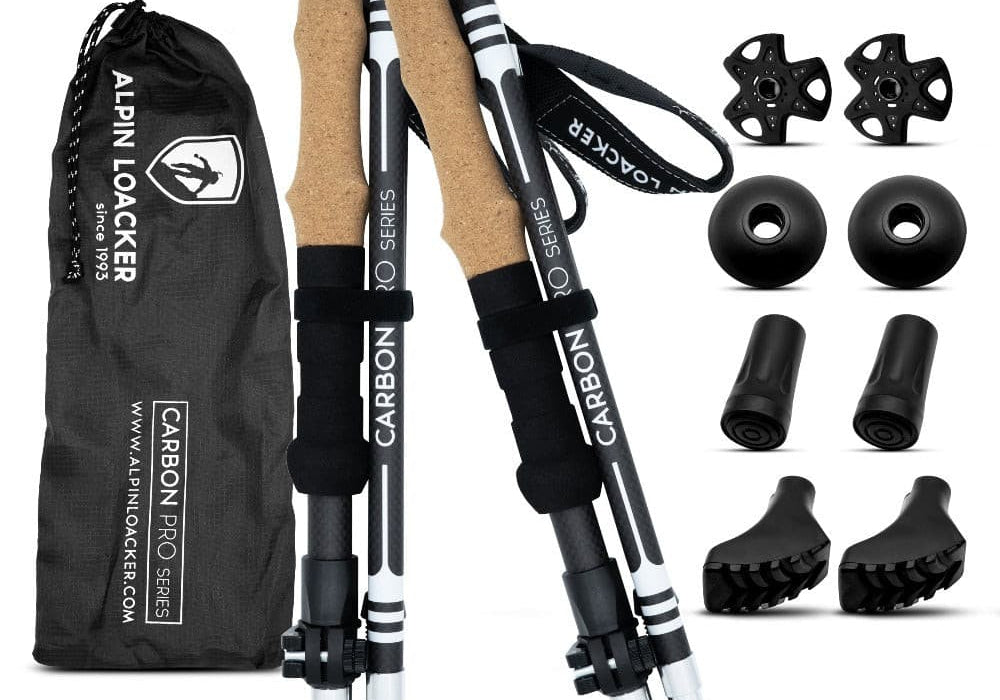
That’s also why the handles of hiking poles should be made of at least foam, preferably cork. ALPIN LOACKERHiking Poles feature exclusively sustainable cork handles, the practical handle extension is made of foam. This makes the hiking poles made of carbon or aluminum very comfortable to hold. The palms stay dry and clean.
There is often a shorter and a longer version of the same model. For the Alpin Loacker Carbon Folding Poles, the shorter version is designed for people under 165 cm tall.
The ideal length setting is hard to generalize. However, there are a few tricks to find the perfect length for yourself. Basically, when holding the grip and the pole tip is on the ground, your elbow should form about a 90° angle. Wearing the right shoes is naturally an advantage here. For downhill walking, poles are usually set a bit longer.
Conclusion
As mentioned at the beginning, neither material is better or worse than the other. It really depends on your personal preferences and intended use. Whether you choose carbon or aluminum hiking poles is entirely up to you. The choice depends on various factors, including weight, durability, vibration damping, and price. Carbon poles are lighter, offer optimal vibration damping, and are stiffer, while aluminum poles are more affordable and robust. Both materials have their pros and cons, so it’s up to you to make the right choice.
FAQ on the Topic: Hiking Poles - Carbon or Aluminum?
What Should You Keep in Mind When Using Hiking Poles Going Downhill?
When going downhill, you can generally set your hiking poles a bit longer. It’s important that you hold the grip in your hand and the pole tip touches the ground while your elbow forms about a 90° angle. Wearing suitable shoes is also beneficial to ensure optimal balance and support. The pole length can be adjusted individually for comfortable and effective use during descents.
Which Is Lighter: Carbon or Aluminum Hiking Poles?
Carbon hiking poles are generally lighter than aluminum hiking poles. Carbon is a lightweight material with high strength, which makes carbon poles weigh less. This makes them especially suitable for long hikes or activities where every gram counts. Aluminum hiking poles are somewhat heavier in comparison but offer a good balance between weight and durability.
You Might Also Be Interested In:
More Helpful Guides
- Hiking Poles Test 2026: Carbon vs. Aluminum – Comparison Tables & Buying Guide
- How to Use Hiking Poles Correctly: Tips That Really Help
- Which Hiking Pole Tip for Which Terrain?
- Knee Pain After Hiking: Causes & Tips
Our hiking poles: Telescopic Hiking Poles | Foldable Hiking Poles
grüezi
ich habe carbon pro stöcke und bin sehr zufrieden. leider sind aber die spitzen schon verbraucht, bzw. nicht mehr vorhanden. wie kann ich diese ersetzen.
herzlichen dank und gruss