




You're facing a decision: trekking poles carbon or aluminum? Don't worry, you're not alone. Countless outdoor enthusiasts ask themselves this question before choosing a new pair of trekking poles. One thing upfront: neither of the two materials is fundamentally better or worse. Rather, it depends on your personal preferences, your area of use, and your budget. To make your choice easier, we've compiled the most important features, advantages, and differences for you – including all the information you need as a beginner.
Trekking poles carbon or aluminum: What's the difference?
Hardly any topic generates more discussions in outdoor forums than the choice of material for trekking poles. While some swear exclusively by carbon, others will only consider aluminum. But what are the actual differences between the two materials?
Carbon is a high-strength composite material that is particularly lightweight and stiff. Aluminum, on the other hand, is a proven metal that impresses with its robustness and flexibility. Both materials have their place and are suitable for different tour profiles. Those seeking a comprehensive overview will find all relevant details at a glance in the large trekking poles test 2026 with carbon vs. aluminum comparison.
Carbon trekking poles in detail
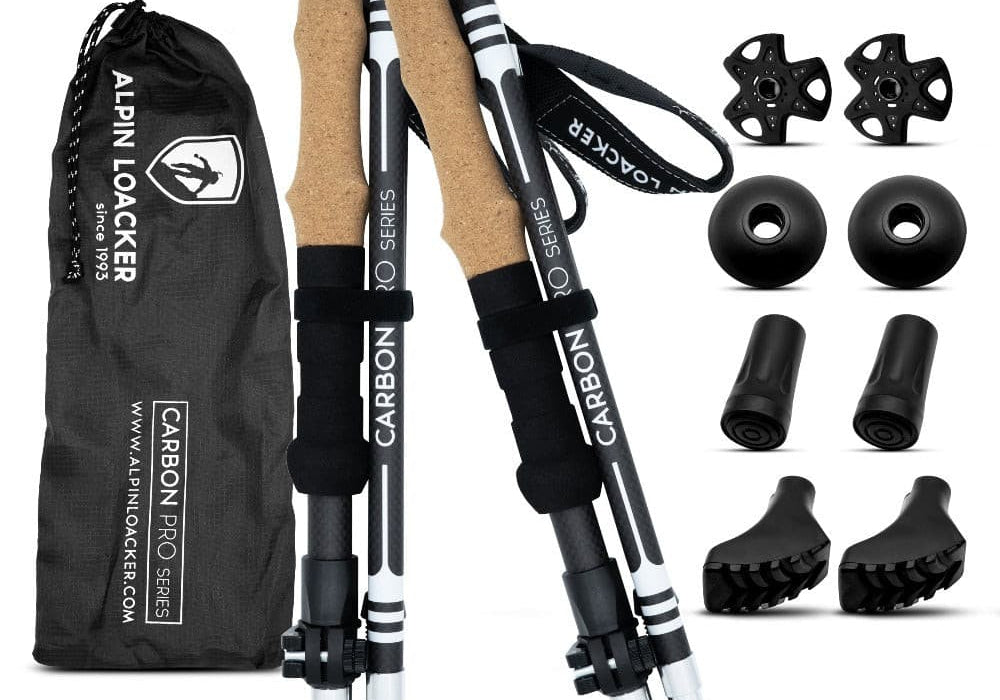
Trekking poles made from carbon are, as the name suggests, made from carbon fibers. At Alpin Loacker, we rely on high-quality 3K carbon, which is significantly more robust compared to conventional carbon poles. Trekking poles made from carbon are generally more expensive than aluminum poles, but in return they are lighter and ideal companions for long hikes.
Advantages of carbon trekking poles:
- Significantly lighter than aluminum poles – ideal for long tours
- Optimal vibration damping through the damping properties of carbon fibers
- High rigidity – hardly twists at all
- Very comfortable to carry on your backpack
Disadvantages of carbon trekking poles:
- Breaks more easily than aluminum under extreme loads
- Lower notch sensitivity
- Higher price
If you regularly hike long distances or in steep terrain, it's worth taking a look at the perfect balance of lightweight and robustness in carbon trekking poles.
Aluminum trekking poles in detail
Our aluminum trekking poles are made from lightweight aircraft aluminum. However, they are somewhat heavier than carbon models. Since aluminum has lower rigidity, vibrations are transmitted rather than absorbed – unless the poles are sprung. On long hikes, this can be tiring. In return, aluminum offers a decisive advantage: under high loads, it bends but rarely breaks.
Advantages of aluminum trekking poles:
- More affordable to purchase
- Bend under load rather than break – no risk of injury from splinters
- Very robust and suitable for everyday use
- Ideal for beginners and occasional hikers
Disadvantages of aluminum trekking poles:
- Heavier than carbon models
- Can permanently bend under heavy load
- Less vibration damping
What types of trekking poles are there?
In addition to the material question, the design also plays an important role. Whether you choose carbon or aluminum trekking poles – when it comes to the mechanism, there are two popular variants: telescoping poles and folding poles.
Telescoping trekking poles
Stable telescoping poles are easy to compress. The lighter they are, the better. The individual segments are either screwed or locked with clamps for fixation. Thanks to their compact packed size, telescoping poles are ideal for storing on your backpack when you don't need them. They are particularly flexible in length and adapt optimally to climbs and descents.
Folding trekking poles
Folding trekking poles are folded together via an internal tension cable – similar to a tent pole. This gives them an extremely small packed size and they even fit in your backpack. Those who travel frequently or hike with light luggage will find valuable tips in the article on folding trekking poles for winter hikes and compact backpack trips.
Which material suits your area of use?
The choice between carbon or aluminum depends largely on how and where you are active:
- Long trekking tours & alpine hikes: Carbon is ideal here because the lower weight is noticeably less tiring over many kilometers. More details in the article on carbon trekking poles for long trekking tours and steep climbs.
- Occasional hikes & beginners: Aluminum is more affordable, robust, and forgiving – perfect for getting started.
- Winter tours & snowshoe hiking: Both materials work. What's important here is the right technique – tips are in the article How to use trekking poles correctly in the cold months.
- Varying surfaces: Be sure to choose the right tip – find details in the guide on trekking pole tips for different surfaces.
Frequently asked questions about carbon or aluminum trekking poles
Are carbon trekking poles really better than aluminum?
Not necessarily. Carbon is lighter and dampens vibrations better, which is especially an advantage on long tours. Aluminum, on the other hand, is more robust and cheaper. For beginners and occasional hikers, aluminum poles are often the better choice, while ambitious hikers and mountaineers usually benefit from carbon.
How much should trekking poles weigh?
A good pair of carbon trekking poles weighs between 380 and 480 grams. Aluminum models usually range between 500 and 650 grams per pair. The lighter the poles, the more pleasant it is to carry them for several hours – but it's also important that stability doesn't suffer.
Do carbon poles really break that easily?
High-quality carbon like the 3K carbon we use easily withstands most loads. Carbon poles can break mainly if they get stuck or are extremely stressed sideways. With normal use on hikes, they are reliable and durable. Those wanting to play it safe prefer aluminum for alpine via ferrata and very rough terrain.
grüezi
ich habe carbon pro stöcke und bin sehr zufrieden. leider sind aber die spitzen schon verbraucht, bzw. nicht mehr vorhanden. wie kann ich diese ersetzen.
herzlichen dank und gruss