



Trekking Poles Test 2026: Why Good Poles Make Every Elevation Gain Easier
Trekking poles are no longer accessories used only by older hikers. Anyone who regularly explores the mountains knows: Good poles reduce knee strain on descents by up to 30%, provide stability on uneven terrain, and noticeably reduce overall strain. But which models really convince in the Trekking Poles Test 2026 – and is the premium price for carbon really worth it?
In this guide, we compare the most important materials, designs, and use cases. You'll learn what really matters when buying – and which model suits which type of hiker.
Carbon vs. Aluminium: The Big Material Comparison
The material question is the most important decision when purchasing. Here are the key differences at a glance:
- Weight per pole: Carbon approx. 230–260 g | Aluminium approx. 235 g (Light) to 292 g (Expedition)
- Vibration damping: Carbon excellent | Aluminium moderate
- Breaking behavior: Carbon breaks suddenly (splinter fracture) | Aluminium bends first
- Price: Carbon approx. €80 | Aluminium approx. €30–50
- Ideal for: Carbon = Multi-day tours & ultralight trekking | Aluminium = Family hikes & via ferrata
Material verdict: Carbon is suitable for ambitious mountain tours, aluminium for durability and beginners. Those counting every gram on long trekking expeditions will find more details in our article on carbon trekking poles for long treks. The topic of balancing lightness and durability is also worth exploring.
Telescopic Poles vs. Folding Poles: Which Design Is Right for You?
In addition to material, the design determines comfort in everyday use. The key differences:
- Packed length: Telescopic approx. 60–70 cm | Folding approx. 35–45 cm
- Adjustability: Telescopic infinitely variable | Folding often fixed or limited
- Setup time: Telescopic 5–10 seconds | Folding under 3 seconds
- Stability: Telescopic very high (cam lock) | Folding high (pull system)
- Ideal for: Telescopic = Multi-day tour, trekking | Folding = Trail running, via ferrata
Design verdict: For most hikers, telescopic poles are the better choice. Folding poles excel in packed size – for those wanting to travel compact, our guide to folding trekking poles offers more tips.
Setting the Right Length
Basic rule: 90-degree angle at the elbow when standing upright. Simple formula: Body height × 0.68 = approximate pole length.
- Uphill: 5–10 cm shorter
- Downhill: 5–10 cm longer
- Traversing: Shorter on uphill side, longer on downhill side
Our article explains how to use the poles correctly: Using trekking poles correctly for the 2026 outdoor season.
Which Trekking Poles for Which Hiker Type?
Not every pole suits every purpose. This overview helps you choose:
- Beginners: Aluminium, telescopic – focus on durability & value for money
- Regular mountain hikers: Carbon or aluminium, telescopic – weight & grip comfort matter
- Multi-day trekking: Carbon, telescopic or folding – weight & packed size
- Trail runners: Carbon, folding – packed size & setup speed
- Via ferrata: Aluminium, telescopic – durability, no splinter fracture
- Winter hiking: Aluminium, telescopic – wide snow baskets & cold stability
For winter, also pay attention to tip selection – find details in our guide Which tip for which terrain?
What to Watch for When Buying
1. Grip and Strap
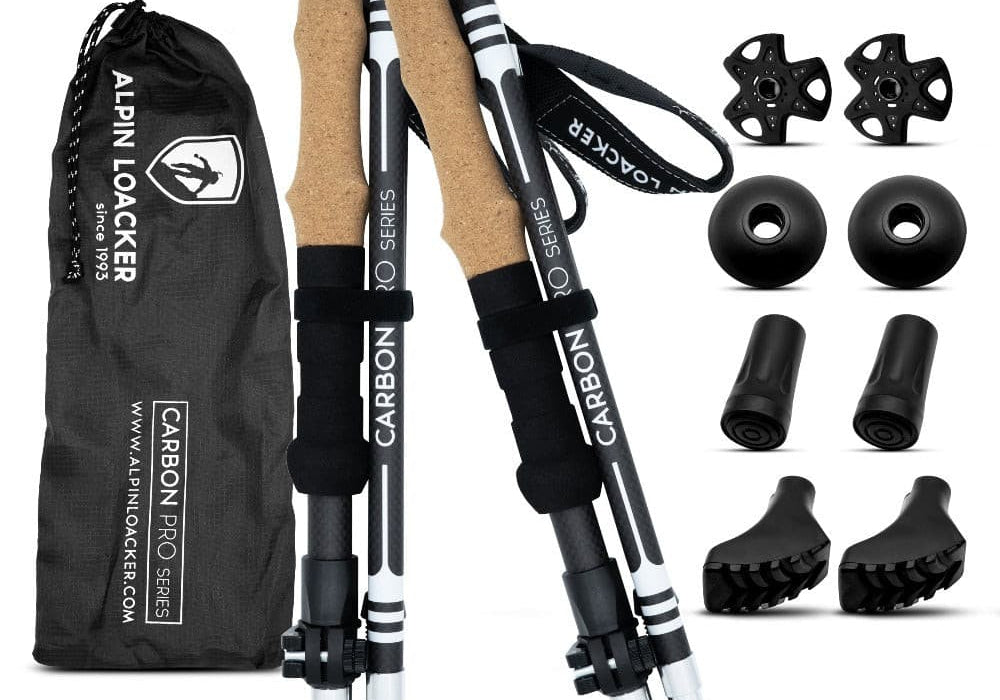
Cork is the premium grip material: adapts to your hand shape, doesn't sweat, and feels comfortable even when wet. Always thread the strap from underneath through the ring – this transfers force without cramping the pole.
2. Tips and Baskets
Carbide tips are durable on rock. In winter, wider snow baskets are used. You'll find matching accessories and spare parts directly in the Alpin Loacker Shop.
3. Locking System: Twist-Lock vs. Flick-Lock
Flick-Lock is clearly superior for alpine use: You can immediately see if the pole is correctly locked, and you can adjust it even with gloves on.
Care: How to Keep Your Poles Forever
- Separate and dry after each tour
- Rinse segments with clear water
- Replace worn tips promptly
- Never bend carbon poles (splinter fracture risk)
Frequently Asked Questions About Trekking Poles (FAQ)
Do I Really Need Trekking Poles?
Studies show a reduction in knee strain of up to 30%. Anyone who experiences knee pain while hiking or regularly does multi-day tours definitely benefits – not just downhill, but also for overall endurance.
How Do I Transport Trekking Poles on an Airplane?
Only in checked baggage – they're not allowed in carry-on. Folding models fit in most standard suitcases and are ideal for travel.
What Should I Wear for a Mountain Tour?
The right clothing is just as important as the right equipment. We recommend merino wool as a base layer – temperature-regulating, odor-neutral, and unbeatable on multi-day tours. Also, merino socks are a worthwhile investment.
Conclusion: Which Trekking Poles Are Worth It in 2026?
Carbon is the right choice for ambitious tours and ultralight trekking, aluminium excels in durability and on via ferrata. Telescopic poles offer maximum flexibility, folding poles the best packed size. If you pay attention to grip (cork), flick-lock fastening, and carbide tips, you'll enjoy your poles for years – whether in summer or in the winter high mountains.